“Companies that have done a reasonable job of setting clear goals for employees have been more profitable than those that haven’t. They are also better at avoiding waste from allocating resources on low-priority projects because of guidance through well-defined quarterly goals.” 1
Prioritization
How to ensure we are prioritizing the right thing?
Focus on what delivers most value, given core business goals; not nice-to-haves, and distractions from the core goals (for example, we would choose to prioritise very different objectives based on if the core business goals were to drive revenue, as opposed to daily active users). For each objective you are considering prioritising, always assess the ROI (return on investment) by weighing the resources you will need to invest (ie. tech, human, time etc) against the impact of achieving the objective (eg. increasing revenue, daily active users etc). To ensure the goals we are setting will drive key metrics and deliver a high return on investment, goals should be defined as metrics we intend to uplift, not binary deliverables; so rather than setting a goal as “release new feature”, we should set the goal as “15% uplift in daily active users”, or “”5% revenue uplift”, depending on which metric you intend for your initiatives to uplift.
Cascading goals promotes alignment. This approach allows for all teams working towards the same high-level goals, while maintaining their autonomy and finding ways to contribute to the company goals within their scope/ domain.
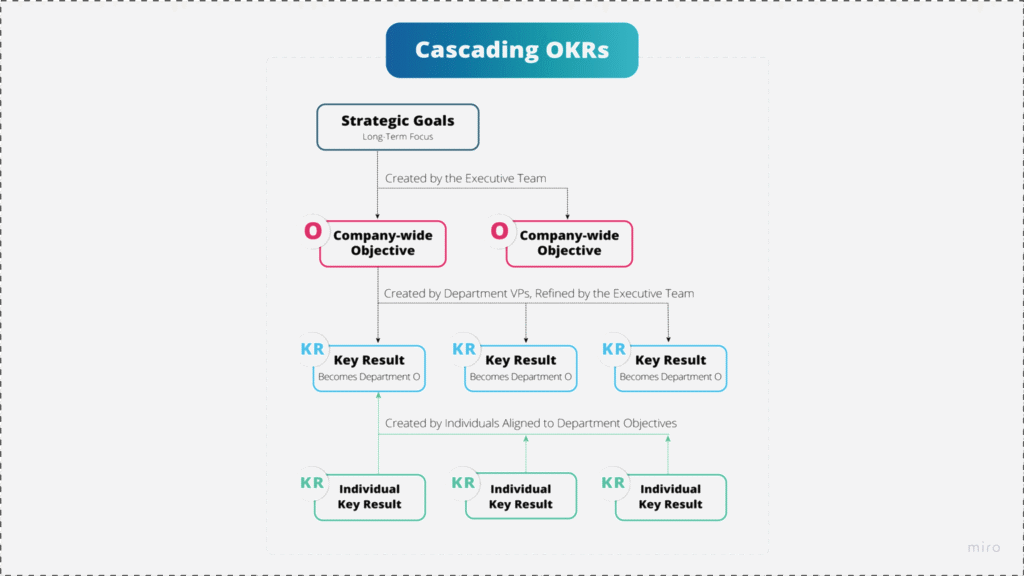
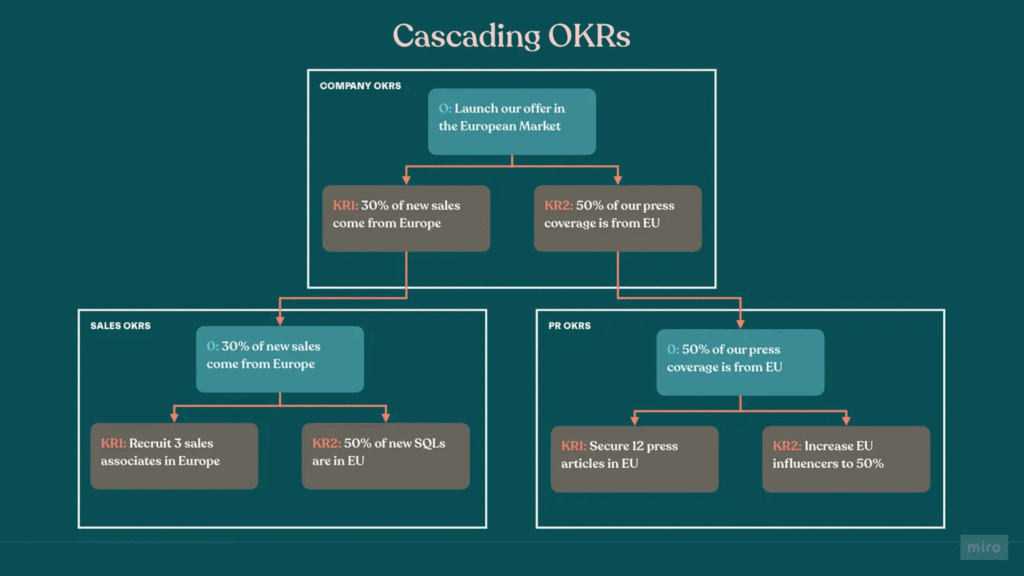
The goal is to create clear shared department objectives for your team members to create supporting Key Results, where every department objective supports the organization-wide objective; the result is alignment, top-to-bottom.
Some organizations find “cascading goals” too rigid, and opt instead for an “aligning goals” model, which the following diagram outlines nicely:
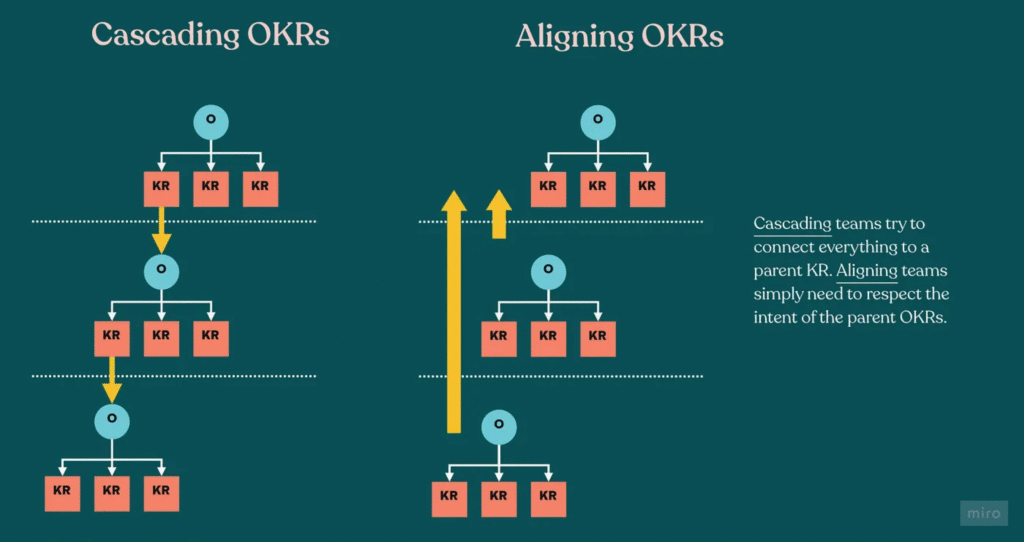
Aligning goals aims to solve some inherent problems with rigidly cascading goals2:
- It assumes your strategy is perfect.
- It’s expensive and slow to move.
- It leaves many teams on the sideline.
If you are a senior leader and are involved in determining how OKRs should be set in your organization, then I would advise exploring both approaches, and determining which works better for the organisation’s culture (eg. top-down vs bottom-up etc).
Whichever approach suits the organisation better should not be a major concern as a team manager, as both approaches promote alignment, which is what, at the end of the day, is most important and drives results.
Follow the data! Use past user or performance data to inform where to focus on next. This is the objective approach; experience is great, but the world changes fast, and what was true a year ago may no longer be true; user data is accurate and up-to-date, and therefore more trustworthy; this approach is tried and tested in the industry3. Initiatives should be rolled out in small interactions, where we experiment and validate assumptions at each step, so that we move onto the next step as well informed as possible. The extent of the experimentation or data available can be limited by your budget, but investing in this area will save considerable costs in the long term.
Timelines
Annual goals establish an overall direction and vision, outlining high level objectives and key areas of focus for the entire year. They allow the company to validate that all team and department level goals are aligned with the company’s broader strategic goals. As with all goals, annual goals should be measurable to be meaningful; the SMART guidelines are a popular and useful set of things to keep in mind when setting goals4. Annual goals can additionally be used to inform the allocation of resources, ensuring that the company is investing in the most impactful areas. While annual goals serve their purpose, they are long-term goals, and don’t always make it clear where to focus, and while developing a roadmap around the annual goals can mitigate this problem, a more effective approach is to define more specific quarterly goals that should accomplish the overarching annual goals.
Quarterly goals are flexible and allow for immediate focus and quick adjustment. OKRs (Objectives and Key Results) are a great framework to define ambitious, measurable quarterly goals and track progress5. The framework works by setting a set of 2-4 objectives and key results:
-
Objective
What we want to achieve (business goal); should be specific, concrete, and qualitative. -
Key-Results
How we will achieve (milestones); should be quantitative, achievable, and measurable.
While some sources refer to SMART (Specific, Measurable, Achievable, Relevant, Time-bound) as an alternative framework to OKRs, I consider SMART to be more guidelines than a framework, and have found them useful to keep in mind when defining key-results.
To encourage ambitiousness, goals should go beyond successfully meeting expectations. An approach I’ve seen work effectively is to add a 20-30% “ambitiousness buffer”, so that if 70-80% of the goal is accomplished then the goal should be considered a success, and achieving 100% would be overachieving. While this might seem counterintuitive, the reality is that if you don’t set the goal to over-achieve, then you will never over-achieve; so instead we set the goal ambitiously and aim to achieve 100%, but if we don’t quite make it and only deliver 80%, we should still have delivered the core business requirements (which is still a great accomplishment to celebrate). For example, if based on previous performance data we estimate 10% revenue growth this financial year, we would add ~25% as an ambitiousness buffer, and instead set the goal at 12.5% revenue growth this financial year.
Dependencies
For goals that involve multiple teams (ie. It does not fall into a particular team’s scope, or a team has a goal that will require support from other teams), identifying the dependencies between the teams and setting aligned/ shared goals for those teams is well worth the time investment, as it ensures that both teams have the same goal during the same quarter, and are not overloaded with too many other goals at the same time.
Determining dependencies early, and aligning between teams on commitments has been one of the biggest challenges I have faced when planning and setting goals. Not determining and aligning with dependencies early almost always results in initiatives becoming blocked mid-quarter by downstream dependencies not having allocated capacity to provide support, as they had no goals related to the initiative and now have too many other priorities. My advice; always invest the time in understanding the dependencies involved in you achieving your goals and deliverables, before committing to them.
Footnotes
- Quarterly OKR or Annual OKR – Which is better? (Huminos) ↩︎
- Cascading vs. Aligning OKRs (Tability) ↩︎
- The Rise of the Data-Driven Enterprise (Accenture) ↩︎
- How to write SMART goals (Atlassian) ↩︎
- What are OKRs? A guide to objectives and key results (Asana) ↩︎