Create an environment that motivates individual contributors (ICs) to exceed expectations. The importance of an inclusive environment, where ICs feel heard and respected cannot be understated. One important distinction I like to make is that a manager is not “the boss”, but a member of the team with a different set of responsibilities to the ICs in the team. Therefore, it becomes important as a manager to “manage up”, as well as “manage down”, to ensure the system is functioning efficiently.
Team Building
Team Shape
The current industry standard seems to be a team size of around 5-7 ICs per manager, in modern distributed tech organisations12. This should ensure the manager has capacity to monitor deliverables, attend team ceremonies, regular 1:1s with direct reports and to handle ad-hoc events or requests. It’s worth noting that while this is the team size I am used to managing (and in my experience it has always worked efficiently), organisations that have fewer teams handling large projects, might benefit from a slightly higher team size (eg. 8-15 people per team)3.
A personal insight I can share is that I have found it valuable to have an even spread of seniority and career aspirations in a team. For example, in a team of 6, with 2 senior engineers, it would be preferable that one aspires to be a Staff Engineer (expert track), and one that aspires to be an Engineering Manager (management track). This allows for more easy delegation, as you can assign different types of tasks based on the skillset they are motivated to develop; additionally it avoids the potential situation where the 2 engineers feel they are competing for the same promotion or domains to own. Furthermore, too much seniority can result in ICs feeling they lack upward mobility, and projects to lead.
So a team of 6, might look something like this, in terms of their career aspirations:
- 1x senior (aspiring EM)
- 1x senior (aspiring Staff)
- 2-3x mids (preferably EM & Staff aspiration spread, but often mids are not yet clear on their aspirations)
- 1-2x juniors (preferably a strong junior, aspiring to be a mid; unless there are budget limitations and/ or capacity to invest in mentoring and developing the IC over time)
Obviously this is not always possible, but if you have a large enough pool of engineers to choose from as a hiring manager, then it is worthwhile to keep in mind when shaping a team.
Hiring
The first step in effective team building is hiring the right people. Once you have invested time and resources in recruiting and onboarding a new hire, it’s costly to have to restart the process should the new hire prove to be ineffective. To reduce risk it’s worth investing in the recruitment process, as this is the earliest point in the process that you can flag potential issues and ensure a stable foundation for the team.
Given that candidates have something along the lines of Behavioural, System Design and Live Coding interviews to assess those competencies, as a Hiring Manager I try to focus more on team shape; assessing career aspirations and promoting an even spread of career aspirations within the team.
The most important qualities I have come to look for in new hires are quite simple:
They are motivated to learn new things, and show a history of continuous improvement in their career thus far.
Why? Suggests they will deliver incrementally more value over time 4.
They show signals they want to grow with the company over time, and show an interest in the company and team’s long term vision.
Why? Suggests they will stay with the company, and be a worthwhile long-term investment 5.
They present as a team player and a good personality fit for the company (and existing team, if applicable).
Why? Suggests they will assimilate well with the organisation, and be performant/ engaged 6.
They have existing domain knowledge relevant to the team.
* This can be a strong benefit, especially in seniors, but should not be necessary if they are assessed properly in the other interview rounds, as strong candidates for technical roles should not require deep domain specific knowledge 7.
Why? Suggests they will be able to start taking ownership of complex topics immediately .
Given that we hire on potential, and promote on performance, I believe the preference should generally be to promote internally where possible, in order to:
- Reduce risk: We already know the individual is performant, and a good personality fit for the company and role; with new hires this is always a risk we take on.
- Grow top talent: We spend time onboarding and training new joiners, and when they leave they take all the knowledge and expertise they have gained that the company with them. It should be a preference to retain and grow performant individuals.
Offsites
Its important to bring the team together in a non-work environment. so build relationships and foster a more healthy work environment. We spend 30% of our lives working8. We therefore spend a considerable amount of time with the people we work with; so the relationships between the people in a team, can have a big impact on team performance.
A quarterly offsite where the team take a day to connect in a non-work environment, doing something non-work related (preferably of the teams choosing in advance), is a heathy and common approach organisations take to build relationships and encourage communication, collaboration and engagement9.
Benefits of Offsites
1. Enhanced Team Relationships and Morale:
- Offsites provide a change of scenery and a more relaxed atmosphere, allowing team members to interact in a less formal setting.
- This can lead to stronger bonds and improved communication among team members, fostering a more cohesive and supportive team environment.
- Increased interaction and shared experiences during offsites can boost morale and create a more positive and engaged team.
2. Improved Communication and Collaboration:
- Offsites can encourage open communication and collaboration through team-building activities and shared challenges.
- By working together in a different context, team members can develop a better understanding of each other’s strengths and communication styles.
- This improved communication can translate back into the workplace, leading to more effective teamwork and collaboration on daily tasks.
3. Increased Creativity and Innovation:
- A change of environment can spark creativity and inspire new ideas.
- Offsites provide a space for brainstorming sessions and problem-solving activities, encouraging team members to think outside the box.
- The relaxed and collaborative atmosphere can foster a sense of psychological safety, where team members feel comfortable sharing their ideas and contributing to innovative solutions.
4. Opportunities for Leadership Development:
- Offsite events can reveal natural leaders within the team as they step up to guide and support their colleagues during activities.
- This can help identify individuals with potential leadership skills and provide opportunities for them to develop and grow.
- By observing team members in different situations, leaders can gain a better understanding of individual strengths and weaknesses, which can inform future team development strategies.
5. Strengthening Company Culture:
- Offsites demonstrate that the company values its employees’ well-being and development, which can boost morale and job satisfaction.
- By investing in team-building activities, companies can reinforce their commitment to creating a positive and supportive work environment.
- This can lead to increased employee loyalty and a stronger sense of belonging within the organization.
Delegation
Sometimes your workload as a manager can spike and you can become a bottleneck for the team if you are unavailable. Delegation allows for you as a manager to distribute the load between your direct reports.
An effective tool to delegating is to use the delegation funnel10. Applying this approach to a product development team, might look something like this…
Consider the following list of jobs that any manager needs to ensure are handled:
- Lead sprint ceremonies
- Planning
- Goal setting
- System Design
- Alignment/ Communication
- Performance reviews
- Growth plans
- Technical implementation
Now lets consider the how we might approach ensuring that all these tasks are handled…
Naive Approach:
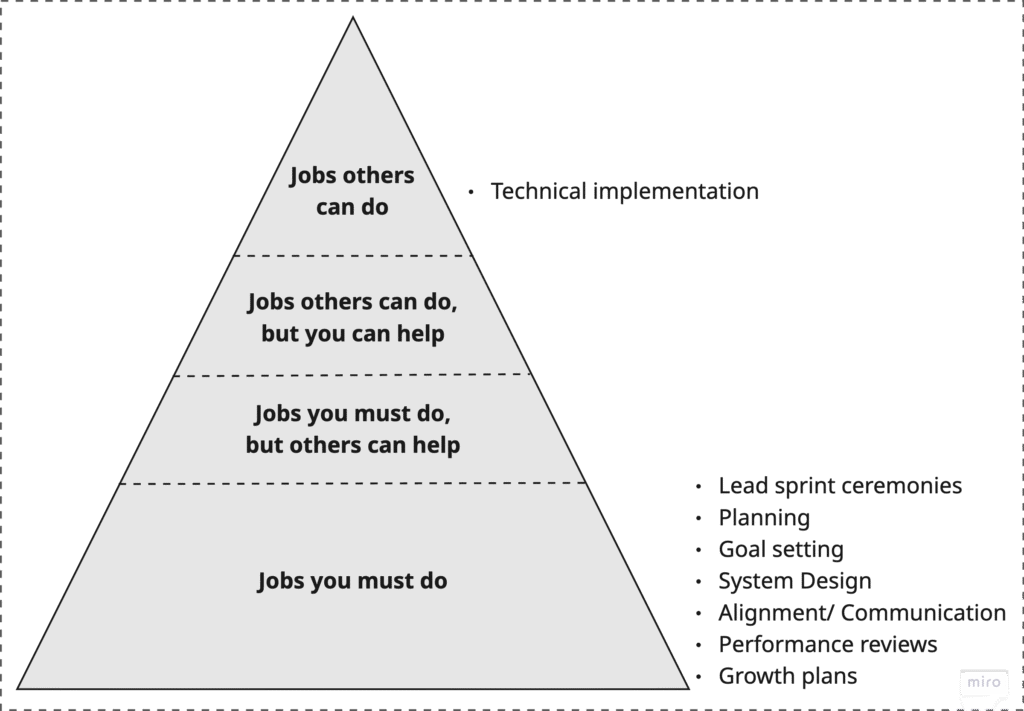
Some managers instinctively try to take on most jobs, as they consider it to be their direct responsibility.
Result: The manager being unable to cope with the load, and becoming a bottleneck for the team.
Recommended Approach:
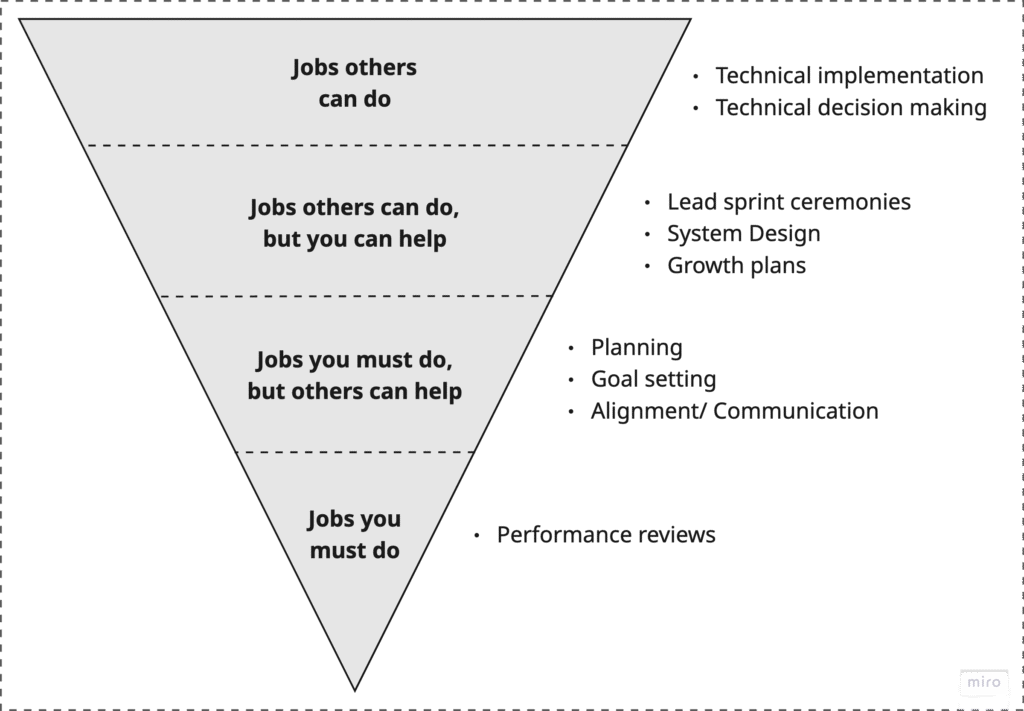
Based on the skillsets within the team certain jobs can be delegated to ICs who are willing and able.
Result: A more even spread of the workload between the team, and the manager cannot become a bottleneck.
The above is just an example of how certain jobs can be delegated, it is NOT a recommendation to delegate all those jobs in a specific way, but rather to show how jobs that might seem like your responsibility, can be effectively delegated to others, and improve efficiency. The recommendation is to review what can be delegated within your team, and delegate what makes sense for your use-case.
If you are struggling to identify what tasks to delegate, here is a useful approach from FasterCapital11:
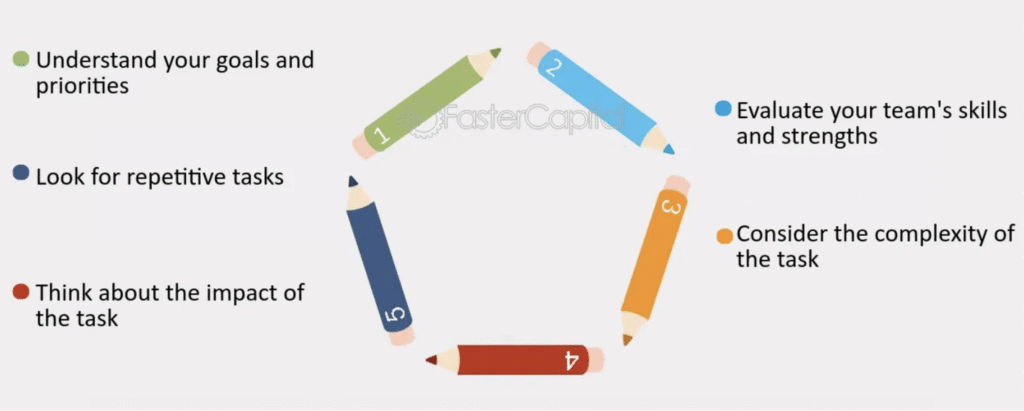
While the benefits of delegation for the manager are clear, delegation is elective, and is generally only effective if the IC is willing to take on the extra responsibility. To motivate ICs to embrace these new responsibilities try to delegate tasks that relate to their career aspirations (eg. I might delegate an “assessment of potential third-party technologies we might adopt” to a Senior aspiring to be a Staff Engineer, but “developing a roadmap for implementing a new feature”, I might delegate to someone aspiring to be an Engineering Manager). This allows individual contributors to develop the skillset they are motivated to develop.
Growth Plans
Careers are a set of stories and narratives that describe accomplishments and learnings from past experiences. When we want to progress in our careers, we generally have 2 options; find upward mobility at our current place of employment, or seek opportunities with a new employer; regardless of which approach we take, we need a “career story” that demonstrates the required skillset for the role.
To keep career stories transferable and relevant to companies across the industry, I encourage my direct reports to focus on developing the skillet required for the industry standard definition of the role, rather than how the role is practiced at a particular company at that particular point in time; for example, to gather their inspiration from well referenced books written by the “best in class”, rather than simply emulating others filling those roles in the existing organization – as companies are evolving systems, and standards can vary based on the companies maturity etc.
Growth plans help keep ICs motivated, and confident they are building a skillset that will help them progress in their career12. They can also help managers delegate in a structured way, as responsibilities can be assigned to ICs, where their ownership is more officially recognised, and they can take these stories and accomplishments with them as they progress in their career.
I’ve found the sweet spot is to have no more than 3-4 goals per year, each with some key results that should accomplish the goal. Setting more than 4 can lead to ICs not being able to focus on goals, and ending up starting all, but not completing any. Inversely, setting fewer than 3 goals can result in accomplishment of the goals not being impactful enough by themselves, to be noteworthy to the company.
In order to give the IC the best chance at recognition from the company, I try to relate some of their personal goals to the company goals or values.
For example:
-
Company Goal:
Reduce operational costs by 5% -
Personal Goal:
Start a cost monitoring process- KR1: Create dashboards and observability
- KR2: Start bi-weekly review process in the team
- KR3: Onboard other teams in the department to the process.
NB. Goals should ideally be SMART, and employee’s encouraged to measure the impact of their initiatives.
Another approach I have found effective, if you work in a company that has a documented “performance matrix”, is to create a map of the performance matrix and ask ICs to track their accomplishments throughout the year, and record examples of each value.
An example “Performance Matrix”:
-
Technical Skills:
- Code Quality: Measured through code reviews, linters, and automated tests.
- Output/Productivity: Track the number of issues resolved, features implemented, or projects completed.
- Performance of Solutions: Evaluate the impact of their work on system performance, scalability, and efficiency.
- Test Coverage: Measure the percentage of code covered by automated tests.
-
Communication:
- Clarity of Communication: Assess how effectively they communicate ideas, technical information, and updates.
- Collaboration: Evaluate their ability to work effectively with team members, stakeholders, and other departments.
-
Teamwork:
- Contribution to Team Goals: Assess how they contribute to achieving team objectives and milestones.
- Mentoring/Coaching: Measure their willingness to mentor junior team members or share knowledge.
-
Problem-Solving:
- Creativity: Evaluate their ability to come up with innovative solutions to technical challenges.
- Resourcefulness: Assess how well they can leverage available resources to solve problems.
-
Leadership:
- Team Motivation: Measure their ability to inspire and motivate their team.
- Delegation: Assess their ability to delegate tasks effectively and provide guidance.
Documenting the individual’s Development Plan, can help structure/ visualise the plan, and track progress over time. Using a standardized template with all your ICs makes the process easier to internalise/ get used to, as a manager, and additionally it makes the process more objective and easier to compare different ICs performance (which is something that you will inevitably need to do at review time, or when considering promotion cases etc). It also ensures that ICs relevant accomplishments are not forgotten at review time; I encourage my direct reports to block off an hour at the end of each sprint, and document their accomplishments, and reflect on how they contributed to their goals.
An example “Development Plan” template:
Goal 1 – IN PROGRESS
Start a cost monitoring process
- KR1: Observability for all key metrics (dashboards etc).
- KR2: Onboard 75% teams in the department to a bi-weekly review process.
- KR3: Achieve at least 2 cost optimisations, based on review process.
Notes:
- Unified Dashboard created
- New review process adopted in team 1
Goal 2 – TODO
[Describe goal here]
- KR1:
- KR2:
Notes:
- …
Goal 3 – DONE
[Describe goal here]
- KR1:
- KR2:
Notes:
- …
Performance Matrix
- Technical Skills:
- 01/01/24: [Relevant accomplishment here]
- Communication:
- 01/01/24: [Relevant accomplishment here]
- Teamwork:
- 01/01/24: [Relevant accomplishment here]
- Problem-Solving:
- 01/01/24: [Relevant accomplishment here]
- Leadership:
- 01/01/24: [Relevant accomplishment here]
Accomplishments
01/01/24: [Meaningful accomplishment here]
Appreciation
Celebrate Wins
Let individual contributors (ICs) know that their work has an impact and is appreciated. When ICs over-deliver and don’t feel that there was any advantage to making the extra effort that they made, then it’s unlikely they will do it again; this is simple negative re-enforcement (ie. when we perform an action and don’t get the desired result, then we avoid that behaviour in future). The goal should be to positively re-enforce desirable behaviors, by recognising and rewarding them; thereby incentivising over-performance13. Creating a culture of celebrating over-performance should always be a north-star, as it creates an environment where the bar is constantly raised as wins are socialised and others try to follow suit (and deliver similar value). A reward system can also be an effective approach, given the company has the budget to implement one, but if it’s not possible, then simple recognition/ celebration of achievements can be very effective in itself.
Empathy
As managers (more so as senior managers), we are always trying to optimize systems, and it can be hard to not fall into the trap of seeing ICs as nodes in a system, and forget that humans are emotional beings, and have personal lives and aspirations, that can heavily affect their performance at work.
Empathy in management is highly important, as it builds psychological safety, where people feel safe to speak up and take risks; increases retention and engagement, as people stay where they feel seen and supported; improves team performance, as people work better when they’re understood, not judged; and helps you navigate conflict or feedback in constructive ways14.
Some behaviours that I have found valuable to practice as a manager are:
- Listen Actively
- Make space for people to speak without interrupting.
- Reflect back what you hear, and make it clear to others that their concerns have been understood and noted.
- Use one-on-ones as genuine check-ins, not just status updates.
- Acknowledge Emotions
- Recognize when someone is stressed, excited, overwhelmed, or disengaged.
- Validate feelings without rushing to solve or dismiss them.
- “I can see this is really frustrating; thanks for raising it.”
- Be Present and Accessible
- Make time for your team – don’t always reschedule or rush through meetings.
- Show up consistently, especially when someone is struggling.
- Practice Compassionate Accountability
- Empathy doesn’t mean lowering standards – it means understanding context.
- “I know you’ve had a tough week. Let’s talk about what’s realistic for now, and how I can support you.”
- Empathy doesn’t mean lowering standards – it means understanding context.
- Adapt Your Communication Style
- Tailor how you communicate to different personalities and preferences.
- Some prefer directness, others need more context or warmth.
- Tailor how you communicate to different personalities and preferences.
- Support Work-Life Balance
- Notice signs of burnout or overwork, and take them seriously.
- Model healthy boundaries yourself.
- Include and Empower
- Ask for opinions, involve others in decisions, and show appreciation for different perspectives.
- Recognize that people may experience challenges differently depending on their background, identity, or role.
While it’s not a requirement, it is certainly beneficial to have held the roles of the people in your reporting line, so you can better understand the problems they face in their roles. If this is not possible, then spending time understanding the roles in your reporting line is a worthwhile investment.
Health Checks
As always, if we want to optimize and improve over time, we need to create observability and monitor performance. Given that an engaging culture is a proven performance driver, monitoring team satisfaction is a worthwhile investment. A popular model, that goes beyond the standard retrospective, is a Squad Health Check 15. The recommended cadence for a health check once per quarter; simply switch out the last retro of each quarter with a health check, and “voila!”
The model involves a set of questions; the guidelines for which are as follows:
- The questions are designed to cover a wide range of different perspectives.
- The default questions are just a starting point. Squads are free to remove, add, or change the questions to whatever they think is relevant.
- Try to limit to 10 questions or so. If we have more questions than that, some are probably too overlapping and can be removed.
For each question, each team member votes/ provides a rating according to the following levels:
- Green (squad is happy with this).
- Yellow (there are some important problems).
- Red (this really sucks).
This results in a great overview of the whole organization’s health, and highlights areas for different teams to focus on, as well as company-wide trends:

To explore Spotify’s health check model further, follow the link to read more…
Footnotes
- First rule of the team: Size (Kirill Kolyaskin) ↩︎
- Agile team size (Techtic) ↩︎
- Software development team size and roles (Onix Systems) ↩︎
- How-to-drive-performance-within-teams (BrightWire Leadership) ↩︎
- 10 reasons why employees stay (Thunderbird) ↩︎
- The Critical Importance of Personality Fit-in-Hiring-avoiding-the-downward-spiral (Jason Phillips) ↩︎
- Domain knowledge vs. technical skills in hiring (Indeed) ↩︎
- One third of your life is spent at work (Gettysburg) ↩︎
- Top-benefits-of-company-offsite-meetings (TravelPerk) ↩︎
- 4 Leadership Practices To Prioritize Your Time And Energy (ClearView Leadership) ↩︎
- Freed Up and Empowered – The Art of Effective Delegation (FasterCapital) ↩︎
- 6 Reasons Why Employee Development Is Key ↩︎
- The power of celebrating success in the workplace (Forbes) ↩︎
- Building a culture of workplace empathy: 10 things your leaders should know (Workhuman Live) ↩︎
- Squad Health Check model (Spotify, 2014) ↩︎